
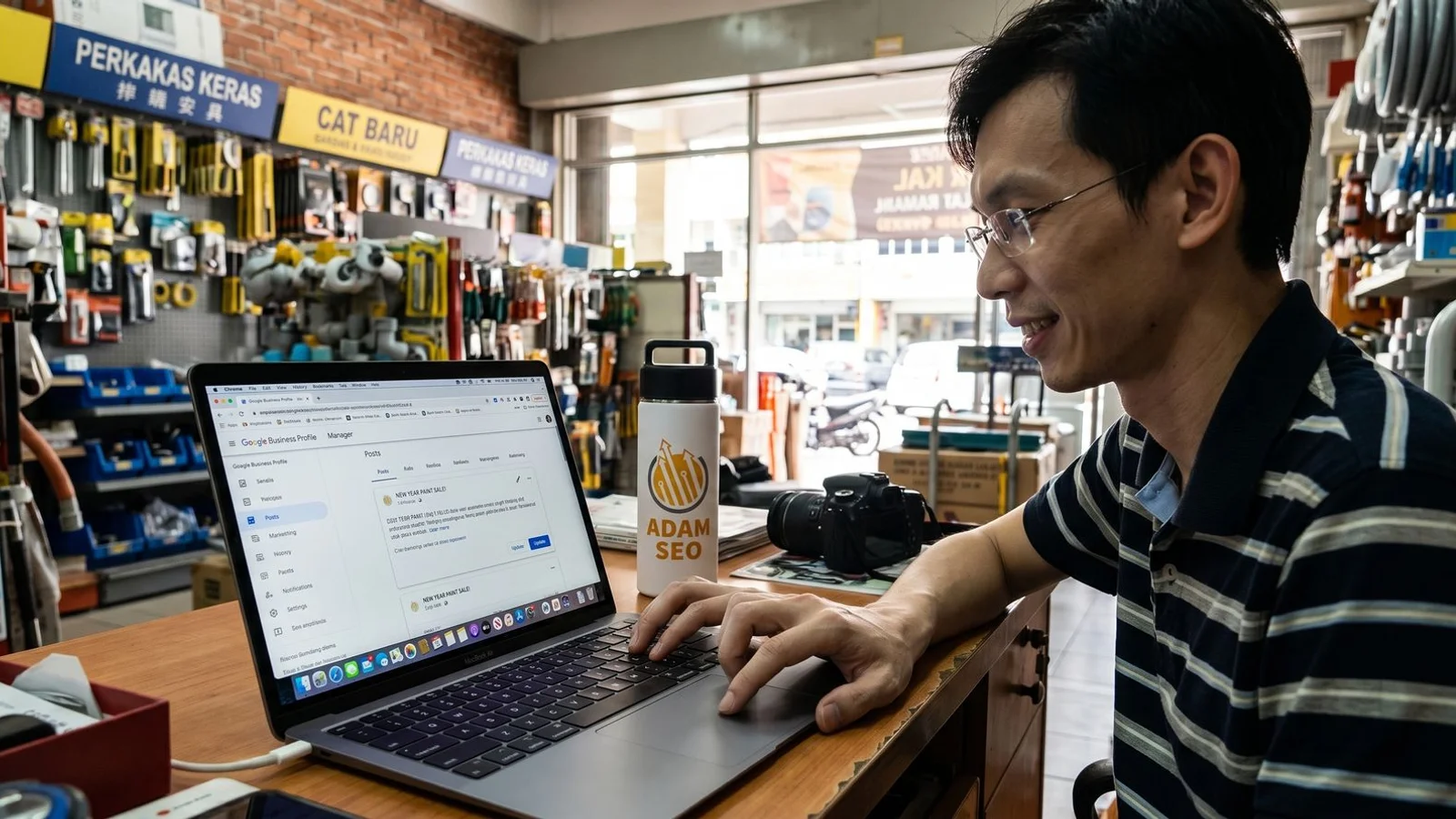
Mastering Google Business Profile optimization Malaysia is the clearest path to outranking less qualified competitors who currently dominate your local search results.
In the Malaysian market, having a physical location is no longer enough to guarantee foot traffic. The reality is that search algorithms now dictate where local customers decide to spend their money.
Our team is going to break down the exact ranking factors that matter right now, looking closely at the latest data.
This guide will walk through a step-by-step framework to turn your profile into a reliable lead generator.
Why Google Business Profile optimization Malaysia is the local SEO priority
Executing proper GBP optimization Malaysia is the fastest way to capture high-intent local demand. Google Map Pack placements directly determine who gets calls and store visits.
Our agency, Adam SEO, was founded by SEO veteran Adam Yong in 2011. He built it on the premise that search engine rankings are meaningless without tangible business results. You will see those results clearly here, as Google controls over 96% of Malaysia’s search market in 2026.
We constantly remind clients that ranking in the top three local spots yields 126% more traffic than sitting in positions four through ten. Most Malaysian SMEs leave their profiles at 40 to 60 percent completion. This means they are losing to competitors with optimized listings.
Our team typically starts every local campaign by closing these specific gaps. Let’s examine the facts driving this urgency:
- Search Dominance: Google Maps is the default navigation tool for millions of Malaysians.
- Instant Action: 76% of people conducting a “near me” search visit a physical location within 24 hours.
- Mobile Priority: Over 90% of Malaysian internet users search via smartphones, making Map Pack visibility critical.
- Traffic Share: Over 70% of local queries now result in a direct profile interaction.
Profile completion: the non-negotiables
A profile reaching 100 percent completion is absolutely mandatory for local visibility. Completing every field gives Google the data it needs to rank your business for relevant Malaysian searches.
We see a significant drop in impressions for listings sitting at 70 percent or lower. The 2026 algorithm update heavily penalizes an incomplete Google Business Profile setup.
Our optimization checklist covers the essential elements:
- Business name: Use your exact registered name. Google strictly enforces name policies in 2026, so adding “Best KL Plumber” will trigger an instant suspension.
- Primary category: This is your strongest ranking signal. Select the most specific match for your core service.
- Secondary categories: Add three to five accurate categories. Overloading this section confuses the algorithm.
- Hours of operation: List standard hours and update them for Hari Raya, Chinese New Year, and other Malaysian public holidays.
- Service area: Draw an accurate map polygon. Do not claim a 100km radius if you only serve a 20km zone.
Paying attention to newer profile features is equally important. Google’s “Ask Maps” AI scans your profile details to answer user queries instantly.
| Feature | Best Practice | 2026 AI Impact |
|---|---|---|
| Attributes | Select all that apply (e.g., wheelchair access, free WiFi). | New sustainability attributes boost local trust. |
| Services | List every offering with accurate pricing. | AI cross-references this with your website schema. |
| Products | Add retail item cards with clear descriptions. | Feeds directly into AI-generated place summaries. |
Primary category selection
Selecting the correct primary category is the single biggest Map Pack ranking signal after physical proximity. Google relies on this setting to match your business with local user intent.
We recommend analyzing your top competitors by searching for your service and city to see what they use. You can often spot their category right in the knowledge panel.
Our experts have identified several common miscategorization traps in the Malaysian market. Picking a broad category costs you valuable traffic.
- Dental clinics: Selecting “medical clinic” loses out to the specific “dentist” category.
- Property agents: Using “real estate agency” instead of “real estate agent” triggers different ranking algorithms.
- Beauty services: Choosing “beauty salon” is less effective than “massage spa” if that fits your core offering.
- Plumbing contractors: Opting for the general “contractor” category hides your profile from urgent repair searches.
We advise against selecting categories for services you do not actively provide. The system actively flags and penalizes inaccurate category stuffing. A highly specific category like “Aesthetic clinic” will easily outrank a general “medical clinic” for targeted queries.
Review generation strategy
Generating a steady stream of positive reviews is a top-three ranking signal for the Map Pack. Recent data shows that 87% of Malaysian consumers read online reviews before making a purchase decision.
Our strategy focuses on consistent velocity rather than just a high total count. A profile with recent feedback outperforms a stale listing with hundreds of old ratings.
We target specific metrics to ensure local dominance:
- Volume baseline: Secure at least 25 reviews to become competitive.
- Market leadership: Aim for 100 or more to lead most local verticals.
- Freshness velocity: Add one to two new ratings every month.
- Score threshold: Maintain a 4.5 average, as anything below 4.0 severely hurts conversions.
Immediate follow-ups drive the most successful Malaysian review tactics. Timing is critical for a high response rate.
- WhatsApp requests: Send a message one hour after service completion.
- Receipt codes: Print a QR code on invoices at retail counters.
- Email prompts: Send a thank-you note with a one-click review link.
We strictly avoid review-gating practices that filter out unhappy customers. Google actively suspends profiles caught manipulating their feedback. The 2026 AI content policy uses automated detection to remove fake, AI-generated reviews in bulk.
Response templates
Responding to every single review is essential for showing engagement and building consumer trust. A 100 percent response rate within 48 hours is a confirmed signal for Google’s algorithm.
Our team uses structured templates to maintain professionalism and consistency. These replies also provide context for Google’s AI summary generator.
We recommend customizing these baseline frameworks for your business:
| Review Rating | Response Strategy | Key Action |
|---|---|---|
| 5-star | Thank the customer by name. | Mention the specific service they loved. |
| 4-star | Express gratitude for the high rating. | Ask what would have made the experience perfect. |
| 1 to 3-star | Acknowledge the issue calmly. | Offer to resolve the problem offline. |
Taking the conversation offline protects your brand reputation. Including relevant keywords in your positive replies helps feed the AI that summarizes your location for new searchers.
Post frequency and content mix
Publishing weekly posts is the minimum requirement to maintain a strong engagement signal. Active profiles rank higher because they show search engines that the business is currently operating.
Our monthly content calendar ensures a healthy mix of promotional and informational updates. The 2026 AI summaries now pull directly from these posts to inform users.
We utilize four primary post types:
- Offer posts: Highlight special pricing, promotions, or limited-time services.
- News posts: Share business updates, new service launches, or team announcements.
- Event posts: Promote webinars, open houses, or seasonal holiday campaigns.
- Update posts: Communicate operational information like new hours or locations.
Every update must include a high-quality image and a clear call-to-action button. You can choose options like Call, Visit, or Learn More to drive direct conversions.
Our team ensures the final text sounds natural and accurate, even when using AI-assisted drafting tools permitted by Google.
Photo standards
Google heavily favors business profiles featuring extensive, high-quality photo libraries. Listings with professional images receive up to 42% more direction requests and phone calls.
Our standard procedure involves uploading a diverse mix of visual content. Google’s Vision AI now “reads” these images to categorize your specific services, making photo quality a direct ranking factor.
We follow strict minimum counts for visual assets:
- Exterior shots: Three images from different angles, clearly showing street signage.
- Interior spaces: Five pictures covering the reception, service areas, and waiting rooms.
- Team pictures: Two photos highlighting your staff.
- Service images: Five visuals demonstrating your products or work.
- Branding elements: A clear logo and a compelling cover photo.
Image quality must meet a minimum resolution of 1080 by 1080 pixels. Ensure the lighting is bright and avoid embedding promotional text directly onto the image.
Our specialists frequently see the system reject photos that look too much like traditional advertisements.
NAP consistency audit
Maintaining exact Name, Address, and Phone (NAP) consistency across the web is crucial for establishing authority. Search engines get confused if your details vary between different digital platforms.
Our quarterly audits ensure this information matches perfectly everywhere. Discrepancies can lead to a drop in rankings or trigger AI hallucinations regarding your location.
We monitor consistency across these critical surfaces:
- Your official company website.
- Social media profiles like Facebook, Instagram, and LinkedIn.
- Local directories including Yellow Pages MY and StreetDirectory.
- Navigation apps heavily used in Malaysia, such as Waze and Grab.
Using a tool like BrightLocal is highly effective for uncovering hidden citation errors. You can also perform a manual Google search using your phone number to find outdated listings.
Our team fixes these errors promptly to send a unified, trustworthy signal to the local search algorithm. Many local clinic owners still refer to it as Google My Business Malaysia, but the principles of NAP consistency remain the same.
Advanced: Q&A seeding
The Q&A section is a highly underutilized feature for capturing local search traffic. Proactively answering customer questions prevents misinformation and builds immediate trust.
Our advanced strategy involves seeding five to ten common questions using a staff account. Providing detailed, high-quality answers populates the knowledge panel with valuable facts.
We prioritize questions covering these three core areas:
- Pricing: Provide clear cost ranges for common services.
- Parking: Explain exactly where visitors should leave their cars.
- Service limits: Clarify what you do not offer to prevent bad leads.
The recent introduction of Google’s “Ask Maps” feature makes this even more valuable. The Gemini AI scans your seeded Q&A to generate instant conversational answers for mobile users. Giving the AI accurate data ensures it represents your business correctly.
Measurement and reporting
Tracking the right metrics is the only way to prove your optimization efforts are working. The revamped GBP Insights dashboard offers advanced analytics, including clear conversion tracking.
Our monthly reports focus on tangible actions rather than vanity metrics. A profile optimized for genuine local demand will see a steady increase in discovery searches.
We monitor these five critical data points:
- Total impressions across search results and Maps.
- The ratio of direct brand searches to broad discovery searches.
- Customer actions, including phone calls, direction requests, and website clicks.
- The monthly growth in your review volume.
- Engagement rates and views on your weekly posts.
Focusing on the actions taken by potential customers provides the clearest picture of success. Impressions are nice, but driving foot traffic and generating qualified leads is the primary goal.
Next steps
Google Business Profile optimization Malaysia is one component of local SEO. If you are unsure whether your current efforts are working, read Signs Your Local SEO Is Underperforming.
If you’re comparing DIY vs agency investment, read How Much Does Local SEO Cost in Malaysia?. For Map Pack specifics, see How to Rank in Google’s Map Pack for Kuala Lumpur Searches.
Or request a free GBP audit, and we will benchmark your profile completeness, review position, and category fit against top Malaysian competitors.