
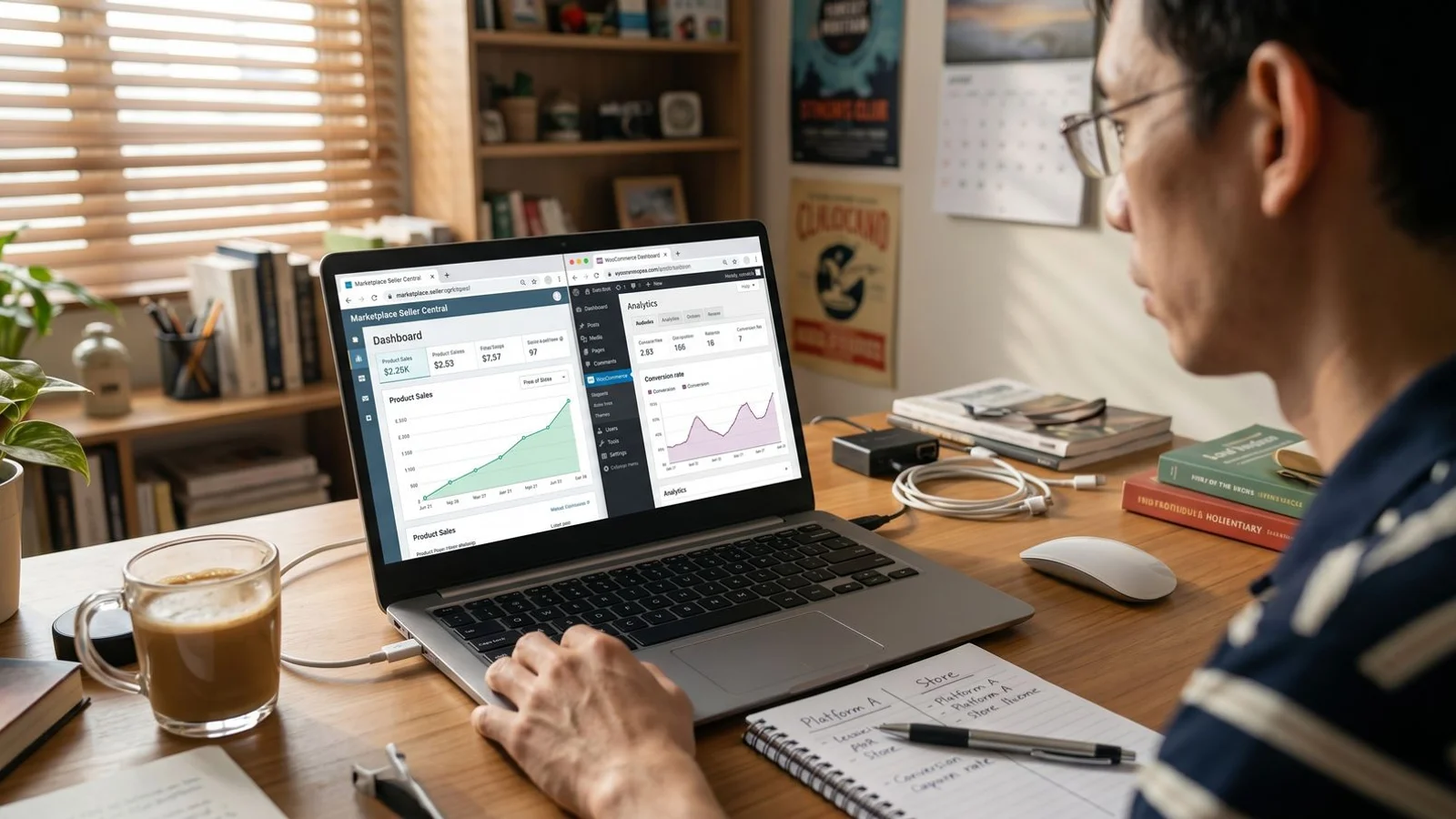
The strategic question Malaysian sellers face
We hear this exact question from local merchants almost every week. The answer is usually to run both channels, but you must stagger the investment based on your current cash flow and business maturity. Getting the budget split wrong leaves you either capped by marketplace margins or starving for traffic on a website nobody visits.
Deciding between marketplace seo vs website seo malaysia is the first major hurdle.
Our recent market analysis shows Malaysia’s e-commerce sector hitting a massive $12.18 billion valuation in 2026. This growth means the stakes are higher than ever for choosing the right platform mix. Let us look at the data behind channel profitability and walk through a clear roadmap for scaling your operations.
How marketplace algorithms differ from Google
Marketplaces optimise purely for immediate sales velocity and paid ad spend, whereas Google ranks sites based on long-term topical authority.
Our data shows a fundamental difference in how these platforms rank products. Marketplaces reward short-term performance to maximise their immediate commission. Google rewards your website for building long-term trust and answering specific user queries accurately.
Shopee algorithm (simplified)
Understanding shopee seo malaysia requires tracking sales velocity above all else. Shopee updates its ranking factors frequently, but the core focus remains on transaction volume.
Here are the key drivers for 2026:
- Sales velocity: Recent order volume heavily dictates your organic placement.
- Price competitiveness: Algorithms compare your pricing directly to the category median.
- Rating and review count: Both the volume of reviews and the average score matter.
- Store status: Preferred Sellers and Shopee Mall accounts receive major algorithmic priority.
- Feature adoption: Using new native tools like the Shop AI Assistant improves visibility.
- Advertising spend: Shopee Ads provide a direct and immediate visibility boost.
Lazada algorithm (simplified)
Mastering lazada seo means securing official brand status to gain algorithmic favour. Lazada operates on a similar transaction-heavy model with a few unique quirks.
- LazMall status: Official brands receive massive preferential treatment in search results.
- Flagship bonuses: Top-tier stores get dedicated promotional slots and increased visibility.
- Keyword matching: Exact title and attribute matches drive initial search relevance.
- Advertising spend: Sponsored Solutions act as a mandatory pay-to-play feature in competitive categories.
Google algorithm (for own-store)
We approach website SEO entirely differently because Google wants to surface the best answer rather than just the cheapest product.
- Topical authority: Comprehensive content depth proves your expertise to search engines.
- Technical health: Fast loading speeds and solid Core Web Vitals are mandatory for ranking.
- E-E-A-T signals: Demonstrating real-world brand trust and author expertise impacts placements.
- User engagement: Time on site, bounce rate, and return visits validate the quality of your page.
- Backlinks: Mentions from authoritative local sources act as digital votes of confidence.
Margin comparison
Your dedicated website will consistently generate a 20% to 35% higher net margin than marketplace sales once your organic traffic is established.
We constantly see merchants shocked by how much of their revenue vanishes into third-party platform fees. When comparing a marketplace vs own store model, the fee structure is the ultimate deciding factor for long-term survival.
Marketplace margins
The fee structure for local platforms took a massive jump recently. Shopee introduced a new 5% Platform Support Fee effective February 2026, while Lazada raised seller commission rates significantly late last year.
Let us look at a typical breakdown:
- Shopee commissions: 3% to 7% depending on the category, plus the new 5% Platform Support Fee.
- Taxes: All commissions are subject to the standard 8% SST.
- Optional programmes: Free shipping and 10% cashback campaigns add another 5% to 7.42% in fees.
- Advertising: Sponsored Solutions easily consume another 10% to 15% of your revenue for top placement.
Net marketplace margin is typically 15% to 25% lower than a direct website sale of the same product.
Own-store margins
Running your own site removes the heavy platform tax entirely, leaving only payment processing and shipping costs.
- Payment gateways: Local processors like HitPay or iPay88 charge around 1.5% to 3% for FPX (online banking) and DuitNow QR.
- International cards: Stripe charges 2.9% plus RM1.00 but lacks the crucial FPX support Malaysian shoppers prefer.
- Shipping rates: You negotiate directly with couriers for much better margins than platform-subsidised rates.
- Organic sales: Traffic from SEO carries zero marginal cost after the initial investment.
Net own-store margin is 20% to 35% better than the marketplace equivalent once your organic traffic builds.
Brand-equity implications
Marketplaces commoditise your products and actively prevent you from building lasting relationships with buyers.
Our experience proves that relying solely on marketplaces damages your brand equity over a three to five year timeline. Buyers view you as just another anonymous listing on an app. You cannot easily capture customer emails, run retargeting campaigns, or build a unique narrative on a crowded platform.
A dedicated website changes the entire dynamic and allows you to:
- Capture email addresses and phone numbers for direct WhatsApp marketing.
- Create engaging branded content that educates the buyer.
- Launch structured loyalty programmes using local tools.
- Charge premium prices instead of racing to the bottom against cheap imports.
- Control the unboxing and full post-purchase experience.
When to favour marketplace
You should prioritise Shopee and Lazada when you need immediate cash flow or are validating a new product’s market fit.
We recommend a marketplace-first approach for merchants testing new concepts without a large upfront budget. These platforms offer immediate access to millions of active buyers. Shopee even rolled out a 3-month commission-free window for new stores starting in January 2026, making it a highly attractive testing ground.
A marketplace-first strategy makes perfect sense when:
- You are validating demand for a brand new product.
- You sell highly commoditised items where brand loyalty is low.
- Your cash flow cannot support a 6 to 12 month SEO campaign yet.
- Your product has a short lifecycle requiring extremely fast inventory turnover.
When to favour own-store
Prioritise your own website if your products require customer education or have a high lifetime value.
Our agency guides clients toward dedicated websites when their business model relies heavily on repeat purchases. High-value transactions easily justify the upfront cost of direct customer acquisition.
An own-store-first model is the smartest choice when:
- Your customer Lifetime Value (LTV) is exceptionally high.
- Brand storytelling regarding craftsmanship or sustainability drives your sales.
- Your items require detailed sizing guides or technical consultation before purchase.
- You want to build a recurring revenue stream via subscription boxes.
- You have the capital to sustain a 6 to 12 month SEO investment before seeing ROI.
The dual-channel playbook
The most successful Malaysian e-commerce brands operate on both channels by staggering their rollout over an 18-month timeline.
We help clients transition from marketplace dependency to independent profitability using a proven strategy. This staged approach protects your immediate cash flow while steadily building a sustainable, high-margin asset.
Stage 1 (months 0-6)
- Launch your top SKUs on Shopee or Lazada to generate immediate revenue.
- Take full advantage of new seller commission waivers.
- Build the technical foundation of your Shopify or WooCommerce site in the background.
Stage 2 (months 6-18)
- Publish targeted SEO content on your own domain to capture informational searches.
- Use marketplaces strictly as top-of-funnel discovery engines.
- Include packaging inserts in marketplace orders to drive buyers to your website for their next purchase.
Stage 3 (months 18+)
- Your website becomes the primary driver of high-margin revenue.
- Marketplace listings are maintained solely to acquire new customers.
- Exclusive bundles and premium product lines are restricted entirely to your website.
Category-specific considerations
Your product category dictates your ideal channel mix, as certain markets behave entirely differently online.
Our data indicates that consumer behaviour varies wildly depending on the product type. Malaysia’s online shoppers expect different experiences for different goods, so you must align your strategy with their habits.
Here is how specific categories break down in 2026:
- Electronics: This sector makes up roughly 31% of online spending. Use marketplaces for entry-level gadgets and your site for high-end items needing warranty support.
- Fashion and apparel: Modest fashion is booming online. Use both channels heavily, but keep limited-edition drops exclusive to your website.
- Groceries: Fast-moving consumer goods perform best on quick-commerce apps like GrabMart, though a website helps with bulk subscriptions.
- Beauty and skincare: Dedicated sites win here because you can publish educational content and ingredient guides to build trust.
- Services: Always use your own website because third-party platforms are poorly equipped for service booking and scheduling.
Measurement across channels
You must track blended acquisition costs and channel-specific profitability to understand your true margins.
We constantly audit client analytics to expose hidden platform fees that drain profitability. Looking only at gross revenue will blind you to the shrinking margins caused by the 8% SST and new platform support fees.
To accurately compare performance, track these critical metrics:
| Performance Metric | Why It Matters for Your Strategy |
|---|---|
| Blended CAC | Shows your true cost to acquire a customer across all active platforms. |
| Channel LTV | Website buyers usually spend significantly more over their lifetime than marketplace users. |
| Repeat purchase rate | Measures how well you are retaining customers outside of the marketplace ecosystem. |
| Net contribution margin | Reveals the actual profit left after platform fees, payment gateways, and shipping costs are deducted. |
These numbers usually reveal that own-store buyers are dramatically more profitable per customer than marketplace shoppers.
Next steps
Choosing the right platform mix requires a deep dive into your specific product margins and organic search potential.
We highly recommend auditing your current traffic and fee structures before making a move. A proper technical setup will save you thousands in lost margins down the line.
For e-commerce SEO generally, see E-commerce SEO service page.
For platform-specific technical decisions, see Shopify vs WooCommerce SEO.
For product-level optimisation, see Product Page SEO Checklist.
Or request a free dual-channel strategy session and we will model your category-specific marketplace versus own-store split and identify the highest-ROI next moves.