
Our team at Adam SEO has seen a clear pattern emerge with Answer Engine Optimisation since our founding in 2011.
This approach requires patience initially, but the ai search strategy outcomes compound much faster than classic search tactics. A 2026 industry report shows that 62% of search journeys in Malaysia now terminate in an AI overview before a user ever clicks a link.
We know this fundamental shift means users are getting answers without visiting traditional websites. The breakdown below will walk you through the exact 12-month timeline and outline exactly what to anticipate.
The AEO engagement timeline
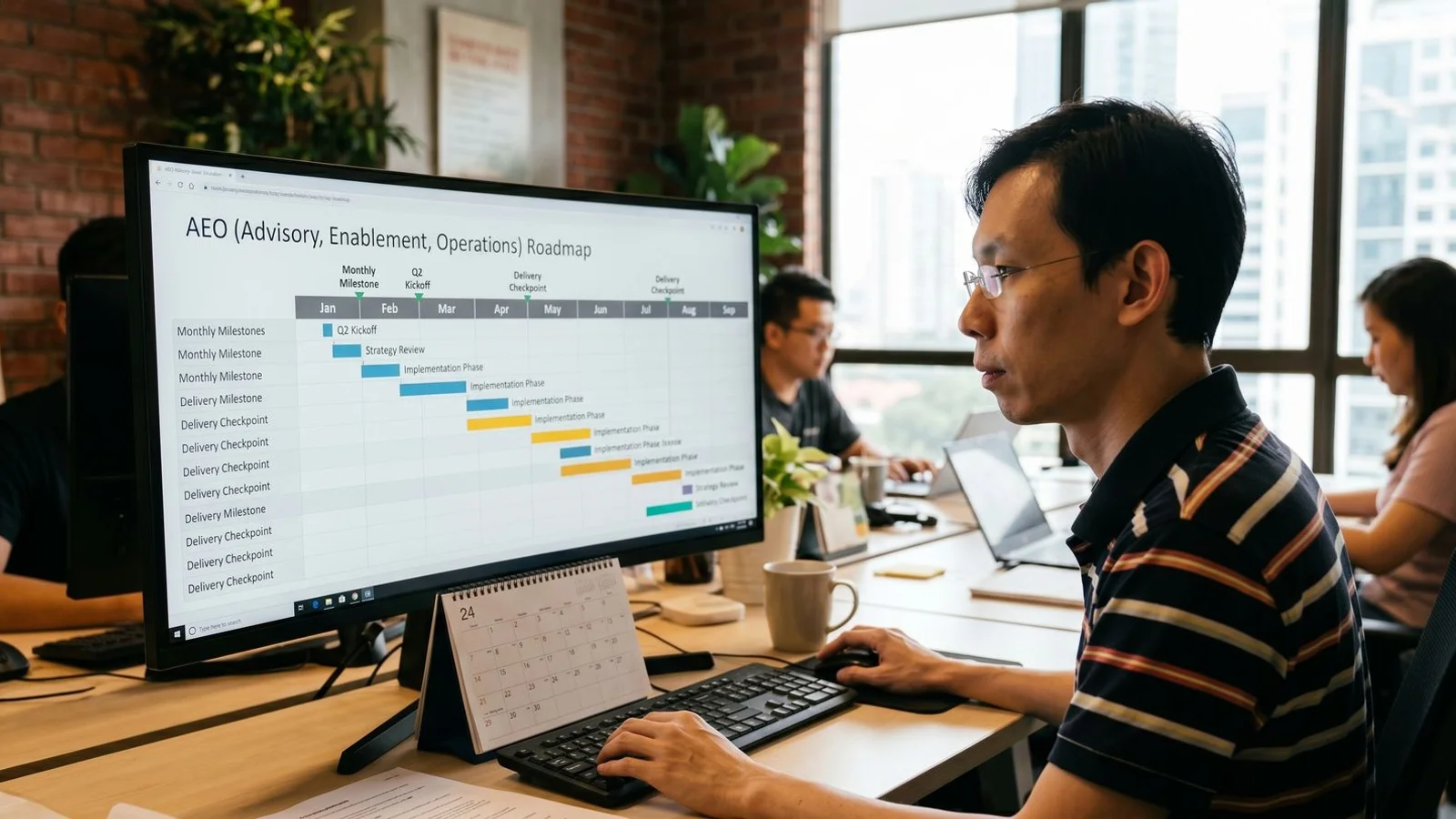
Our typical 12-month engagement for a Malaysian business maps out a structured path to visibility. The aeo timeline requires building foundational entity trust before you see compounding returns on generative platforms.
Month 1: Foundations
Analysing how cleanly AI engines currently recognise your business entity is our first priority. The primary goal is to establish a clear document of your current state. We build a prioritised remediation plan from this data, though you will not see measurable citation gains just yet.
- Entity audit: Checking your Suruhanjaya Syarikat Malaysia (SSM) registration consistency across all digital directories to ensure search engines validate your local presence.
- Schema gap analysis: Identifying exactly what is missing or broken in your website code.
- Author entity mapping: Verifying who writes your content and properly formatting their specific credentials.
- Baseline citation audit: Documenting which AI engines currently cite you for target queries.
Month 2: Schema and entity implementation
Deploying the necessary entity frameworks site-wide takes center stage during this phase. Early AI citation signals start accumulating in the background, but they are not usually visible to users yet. Our technical team ensures everything matches your real-world business records.
- Organization schema: Deployed site-wide to confirm your corporate identity to answer engines.
- Person schema: Added to all author bios to build essential E-E-A-T signals.
- Service, Product, and LocalBusiness schema: Applied where relevant to highlight specific commercial offerings.
- FAQPage schema: Implemented on all customer question sections.
- Google Knowledge Panel: Claimed using consistent NAP data matching your local business records where eligible.
- Wikidata entity: Created or refined to ensure brand appropriateness and global recognition.
Month 3: Content restructure kickoff
We restructure your top 10 highest-traffic pages for direct-answer citability to align with shifting user habits. ChatGPT usage in Malaysia spiked by 330% recently, proving that users prefer conversational answers over link lists. First AI citations typically appear on a handful of long-tail queries with low competitive density during this month.
- Top 10 highest-traffic pages: Restructured specifically for direct-answer citability.
- H2 sections: Opened with 40 to 60 word direct-answer paragraphs.
- FAQ sections: Expanded to match conversational query formats.
- Author bylines: Added to content pages to reinforce trust.
Month 4-5: Cadence build
Building a regular publishing rhythm reinforces entity relationships across your domain. Citation frequency grows noticeably as you establish a steady flow of optimised content. Our team expects you to see 5 to 15 distinct queries citing your brand monthly at this stage.
- Weekly content cadence: Publishing 2 to 4 pieces per month using an AEO-first structure.
- Schema maintenance: Applied carefully on all new pages as they go live.
- Citation monitoring: Conducted weekly across major AI engines.
- Internal linking: Built strategically to reinforce entity relationships and topical clusters.
Month 6: First measurable brand-query lift
Quantifiable revenue impact and lead attribution become clear in month six. Brand-query search volume starts climbing as users search for your name after seeing citations elsewhere. We know from industry data that AI referral traffic converts at an impressive 14.2%, making these early clicks highly valuable.
- Brand-query search volume starts climbing steadily.
- Assisted conversions become visible in your GA4 dashboards.
- Search Console begins showing new impressions on AI-driven queries.
Months 7-9: Compounding
Citation density on mid-competition queries grows significantly during this compounding period. You will see 20 to 50 queries citing you monthly, creating a measurable brand-equity lift. Our strategy reduces competitor citation lockout risk as you establish a firm, authoritative presence.
- Citation density: Grows steadily on mid-competition queries.
- E-E-A-T signals: Mature through case studies, media mentions, and an accumulation of verified reviews.
- Topical authority: Solidifies within your specific niche.
- Competitor citation lockout: Risk drops as you firmly establish your presence.
Months 10-12: Category leadership
Late movers in your vertical will struggle to catch up once this foundation is set. Consistent citation on your most important commercial queries solidifies your category leadership. We consider this the stage where AEO becomes a compounding moat for your business.
- Consistent citation: Maintained on your most important commercial queries.
- AI-answer visibility: Becomes comparable to organic top-3 rankings.
- Brand-query lift: Hits 20 to 40% against your baseline metrics.
- Competitive moat: Forms securely, making it harder for rivals to displace you as a cited source.
Measurement approach
Measuring ai seo outcomes requires triangulating data from multiple third-party tools, manual audits, and user surveys because native reporting is still maturing. Our analytics team relies on a blend of direct and indirect tracking methods to gauge success.
Direct measurement
Third-party tools help automate the tracking process and log citations across different platforms. Manual query audits involve a monthly check of top target queries to see if an AI Overview appears. We actively monitor these citations using a combination of manual checks and specialised software.
- Manual query audits: Monthly check of top 20 target queries to confirm if an AI Overview or answer appears, and if you are cited.
- Profound, Peec AI, and Otterly AI: Third-party tools that crawl AI engines and log citations automatically.
- Search Console experimental AI data: Monitored progressively for Google AI Overview signals, though currently limited.
Indirect measurement
Brand-query volume acts as a strong proxy for AI citation exposure. Direct traffic often increases as people remember your brand from AI answers and type your URL directly. We track these indirect metrics carefully to capture the full value of your AI visibility.
- Brand-query volume: Searches for your brand name acting as a proxy for AI citation exposure.
- Direct traffic: People remembering your brand from AI answers and typing your URL.
- Assisted conversions: GA4 attribution tracked carefully across multi-touch journeys.
- First heard about us survey data: Collected on contact forms and checkouts.
Reporting cadence
Comprehensive monthly reports keep stakeholders informed of progress. These documents must highlight AI citation counts compared to the previous month. Our team includes a clear citation share of voice versus your top three competitors to provide essential context.
- AI citation count versus previous month.
- Citation share of voice versus top 3 competitors.
- Brand-query search volume delta.
- Schema validation status.
- Entity clarity score as an internal metric.
Honest limitations
Current measurement tools have critical limitations regarding tracking fragmentation, attribution opacity, and platform volatility. You must expect fluctuations because AI engines update frequently and intentionally reduce referral clicks.
Our honest assessment is that flexibility is required when tracking these metrics.
1. Tracking fragmentation
No single platform captures everything perfectly, as citation data remains fragmented across every major AI engine today. We use multiple tools to triangulate reality, and manual audits are still necessary to verify the automated reports.
2. Attribution opacity
Users who see you in an AI Overview but skip clicking will not appear in GA4. You are measuring a surface that intentionally reduces referral clicks to keep users on the search engine. We understand this creates a hidden layer of brand awareness that is hard to quantify.
3. Volatility
Frequent updates from AI engines like Perplexity and Gemini require constant adaptation. A query that cites you this month may completely change its sources next month. We see AI citations fluctuate much more than traditional Google organic rankings, which are relatively stable.
What successful AEO looks like at 12 months
A successful 12-month campaign typically results in 30 to 50 queries citing your business across major AI engines. This level of visibility generally drives a 15 to 25% lift in brand-query search volume compared to your baseline.
Our data indicates that businesses investing less typically hit only half of these outcomes in a year. The table below outlines the clear difference in results based on your execution level.
| Metric | Comprehensive Execution (12 Months) | Partial Execution |
|---|---|---|
| Queries Citing Business | 30 to 50 queries across major engines | 15 to 25 queries |
| Brand-Query Search Volume Lift | 15 to 25% increase vs baseline | 7 to 12% increase |
| Assisted-Conversion Lift | Measurable increase in GA4 | Minimal to no visible lift |
| Schema Coverage | Stable coverage, zero validation errors | Frequent validation errors |
| Case Studies Documented | 5 to 10 specific customer outcomes | 1 to 3 generic case studies |
| Citation Share | Top-3 in primary topical niche | Outside the top 5 |
What doesn’t work
Keyword-stuffed tactics and mass-produced AI content actively hurt your citation odds. Answer engines penalise thin, unreviewed content much harder than traditional algorithms do. Our experience confirms that gaming the system no longer works in the generative era.
- Content volume without quality: AI engines penalise thin content harder than Google organic does.
- AI-generated content without review: The irony is that AI engines do not cite AI-generated content back.
- Keyword-stuffed old-SEO tactics: These actively hurt what to expect aeo citation odds.
- Generic schema without entity coherence: Schema without a clean, verified business identity is just noise.
Next steps
Projecting your likely 12-month trajectory depends heavily on your vertical and current entity signals. You can review our foundational guides below to assess your readiness and understand the necessary investment.
We are ready to help ensure your ai search strategy outcomes align with your business objectives.
The first step is gaining foundational context, which you can find in our guide on What Is Answer Engine Optimization (AEO)?. For an urgency assessment, check out AEO for SMEs: Who Needs It Right Now?.
If you need pricing context, review the Cost of AEO/GEO Services in Malaysia. Or request a free AEO readiness audit, and our team will project your exact timeline based on your vertical.