
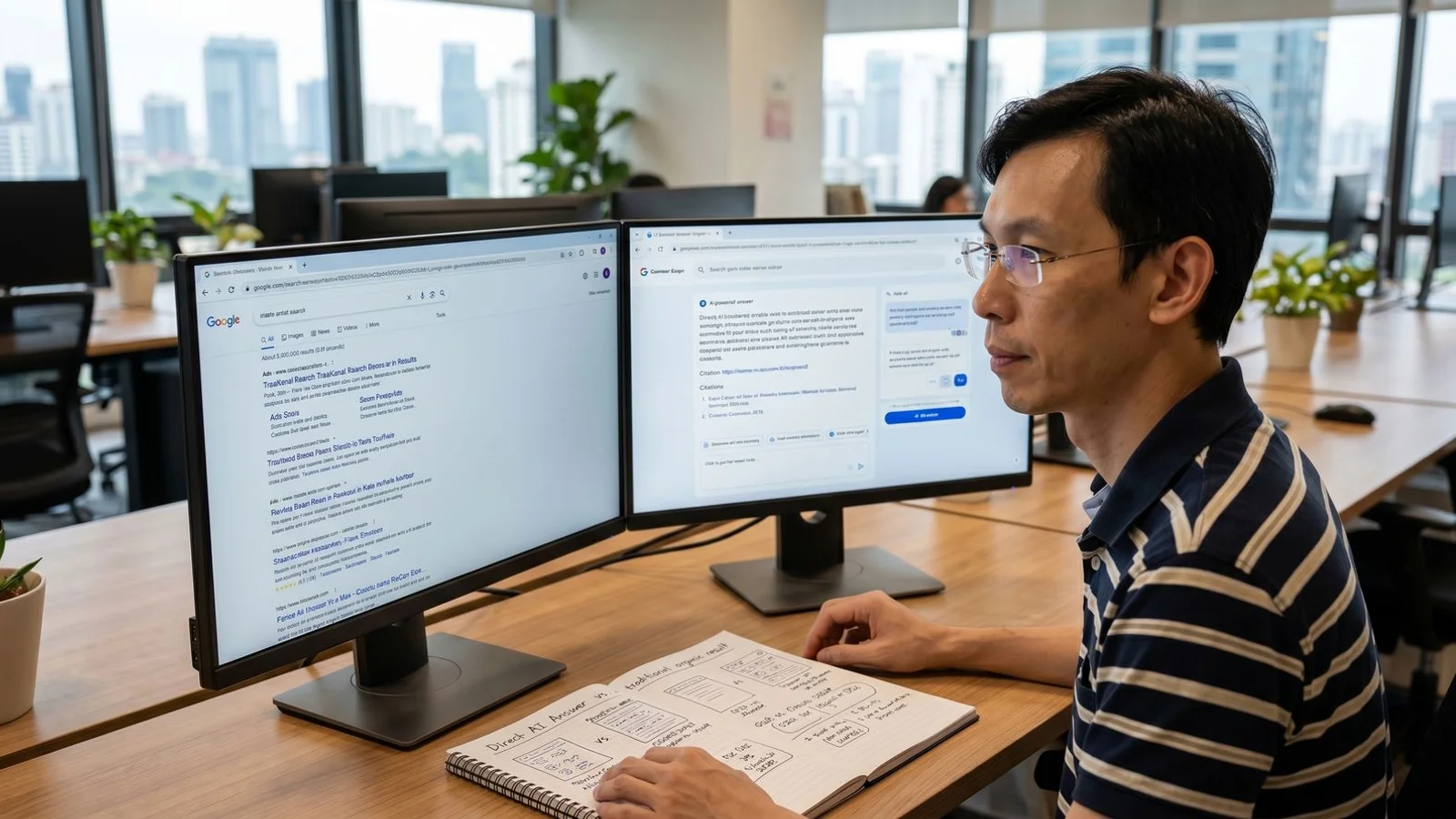
We define what is answer engine optimization as the critical process of structuring your content, entities, and trust signals to ensure AI systems cite your business. This discipline guarantees that platforms like ChatGPT, Google AI Overviews, and Perplexity select your data when generating answers for user queries.
Both approaches remain essential for sustained visibility in 2026.
Our founder, SEO veteran Adam Yong, built this agency in 2011 on the premise that search metrics are meaningless without tangible business growth. AI referral traffic currently converts at 14.2%, which is roughly five times higher than standard Google organic clicks according to 2026 industry benchmarks.
We see clear distinctions between these two overlapping disciplines:
- SEO success: Ranking on page one of Google for your target keywords to earn clicks.
- AEO success: Earning direct citations and links inside AI-generated answers when users ask relevant questions.
Why does AEO exist now?
We point to three major technological shifts that forced the creation of AEO, primarily driven by users wanting immediate answers instead of lists of blue links. The core answer engine optimization meaning revolves around adapting to these generative AI platforms intercepting standard research queries.
This massive shift means traditional ranking strategies lose their effectiveness.
Our recent analyses show that AI Overviews now impact nearly 55% of all Google searches globally. Three specific changes demand your attention:
- Google AI Overviews now serve over 1 billion global users, aggressively rolling out across Malaysia and fundamentally changing how local users find businesses.
- ChatGPT, Perplexity, and Gemini intercept high-intent research queries, with ChatGPT surpassing 800 million weekly active users globally in early 2026.
- AI-answer interfaces display 1 to 5 cited sources per query.
We know that relying on a ten-year-old Google ranking simply fails to capture this new audience. Your brand must become cite-able by AI systems that parse and synthesize facts.
Which answer engines matter in Malaysia?
We track five major AI platforms that dominate the Malaysian search market and directly impact your bottom line. Optimizing for these specific systems ensures your business remains visible to local consumers and enterprise clients.
User behaviors vary significantly across these different search interfaces.
Our direct client data indicates that Malaysian businesses must prioritize their efforts based on these specific platforms. Let’s break down the major players:
Google AI Overviews (Search Generative Experience)
- Visibility: Appears above traditional organic results for qualifying queries.
- Citation Style: Features 2 to 5 linked sources directly within the AI text.
- Local Impact: Reaches millions in Malaysia, with local studies showing top-ranked pages have a 53% chance of being cited.
- Priority: Highest for all local SMEs and e-commerce stores.
ChatGPT search
- Format: OpenAI’s native web search function integrated directly into the chat interface.
- Market Share: Commands a massive 80.15% of the AI chatbot market in Malaysia as of March 2026.
- Citation Style: Provides fast, timely answers with clear links to relevant web sources.
- Priority: High for B2B companies and research-heavy verticals.
Gemini (Google’s standalone AI app)
- Integration: Plugs directly into Google’s massive knowledge graph.
- Market Share: Holds approximately 10.67% of the Malaysian AI chatbot market.
- Priority: Overlaps heavily with AI Overviews.
Perplexity
- Format: Functions as a purpose-built AI answer engine focused purely on research.
- Market Share: Captures about 5.04% of the Malaysian market, processing over 780 million global queries monthly.
- Priority: Moderate for general retail, but extremely strong for thought-leadership positioning.
Claude
- Format: Anthropic’s sophisticated AI assistant featuring live web-search capabilities.
- Citation Style: Generates fewer citations but targets highly technical, complex queries.
- Priority: Growing steadily but currently holds a smaller share.
How does aeo vs seo ranking differ?
We define the core difference in aeo vs seo by looking at the target. Classic search matches queries to web pages, while answer engines match queries to verified entities and claims. This fundamental shift requires moving away from pure keyword density to establish undeniable factual authority.
Our approach treats classic signals like backlinks as inputs, rather than the final destination. AI systems evaluate these inputs to build a trust and recognition layer.
The aeo definition of success relies on these five verification pillars:
- Entity recognition: AI systems must clearly understand your business existence, industry category, service offerings, and founder credentials.
- Claim verification: LLMs cross-reference your factual statements against multiple independent sources to ensure accuracy.
- Schema coverage: Your site code must utilize specific tags like Organization, Person, FAQPage, HowTo, and LocalBusiness for machine parsing.
- Author credibility: Content requires publication under a named, real person with a verifiable digital footprint.
- Citation density: Other highly authoritative domains must mention your brand or quote your original data.
We often compare the two disciplines using this clear framework to help clients understand the transition:
| Feature | Classic SEO | Answer Engine Optimization (AEO) |
|---|---|---|
| Primary Goal | Earning clicks from search result pages | Earning citations in AI-generated responses |
| Core Metric | Keyword rankings and search volume | Entity recognition and brand mentions |
| Trust Signal | Quantity and quality of backlinks | Factual consensus across multiple sources |
What is the entity layer?
We consider the entity layer to be the foundational database of verifiable facts that AI models use to understand the world. An entity represents a distinct, unambiguous concept, person, or organization mapped within systems like Google’s Knowledge Graph.
Large Language Models (LLMs) rely on these defined relationships to generate accurate answers.
Our most critical task in AEO involves ensuring AI systems recognize your business as a concrete entity rather than just a collection of keywords. You must establish these connections clearly:
- Formalize your business: Deploy accurate Organization schema, build a detailed About page, and maintain strict Name, Address, and Phone (NAP) consistency across the web.
- Validate your experts: Use Person schema for your leadership team, maintain detailed author bios, and link out to active LinkedIn profiles.
- Categorize your offerings: Implement Service schema and ensure your product categories match established industry taxonomies.
- Map the relationships: Explicitly state how these pieces connect, such as confirming a specific founder works at your exact location providing a defined service.
We find that when an AI system cleanly maps your entities, your likelihood of being cited increases exponentially.
Is GEO the umbrella term for AEO?
We define Generative Engine Optimization (GEO) as the broader category that contains AEO, entity optimization, and AI-answer experience design. Academic researchers use this acronym to describe the entire field of optimizing for generative responses.
For most practical business applications, GEO and AEO describe the exact same discipline.
Our agency uses AEO in most daily communications because it focuses specifically on what clients actually want, which is earning citations and visibility. The broader GEO umbrella typically covers these specific areas:
- AEO: Securing cited answers inside platforms like ChatGPT and Gemini.
- Entity optimization: Structuring your brand data for the Knowledge Graph.
- Retrieval-augmented generation (RAG) readiness: Formatting internal data so enterprise AI tools can read it.
- Experience design: Crafting content that sounds natural when read aloud by voice assistants.
We focus on the citation aspect because that drives measurable revenue for local Malaysian businesses.
What does AEO work actually look like?
We execute AEO campaigns through a structured combination of technical audits, schema implementation, and strategic content restructuring. This hands-on work directly addresses the visibility gaps preventing AI engines from recognizing your brand authority.
Recent 2026 data from HubSpot indicates that properly structured content gets discovered by generative engines up to ten times faster than standard pages.
Our operational blueprint mirrors the exact processes required to trigger Google’s E-E-A-T algorithms. Concretely, a professional engagement involves these core actions:
- Entity auditing: Assessing exactly how AI systems like Gemini and Perplexity currently summarize your business.
- Schema deployment: Injecting flawless Organization, Person, Service, FAQ, HowTo, and LocalBusiness markup into your codebase.
- Content formatting: Rewriting key pages to feature direct-answer paragraphs, clear definitions, and explicitly cited statistics.
- Author infrastructure: Establishing named, credentialed author bylines linked to verifiable external profiles.
- Citation monitoring: Tracking which AI platforms mention your brand and identifying missed opportunities.
- E-E-A-T reinforcement: Building demonstrable expertise, experience, authoritativeness, and trust across your entire digital footprint.
We continuously iterate on these steps based on competitive gaps. Analyzing why a competitor receives a citation while you remain invisible provides the roadmap for your next content update.
When should you start AEO?
We strongly advise Malaysian businesses to start implementing AEO immediately, as AI platforms are already actively shaping consumer purchasing decisions today. The window for early-adopter advantage is closing rapidly as competitors begin optimizing their own entities.
Analysts at Gartner accurately predicted that traditional search volume would drop by 25% by 2026, meaning those lost queries are now happening inside ChatGPT and Gemini.
Our urgency stems from hard market realities. You need to act now if any of these conditions apply to your operations:
- Complex buying cycles: Your customers conduct extensive online research before purchasing, which is common in B2B and high-ticket B2C sectors.
- Early-adopting industries: Your business operates in financial services, legal, medical, or technology fields where AI answers dominate.
- Saturated SERPs: Your classic SEO strategy has plateaued, and you need new avenues to extend your digital reach.
- Traffic shifts: You notice top-of-funnel informational queries slowly migrating away from standard Google searches.
We know from direct client data that early adopters secure the easiest visibility wins. Late adopters will inevitably pay a significant premium just to catch up to established competitors.
What are your next steps?
We highly recommend expanding your knowledge of what is answer engine optimization by exploring our specialized regional resources. Taking action immediately protects your brand visibility in this rapidly shifting landscape.
Reviewing these materials provides a clear roadmap for implementation.
Our team has compiled several comprehensive guides to help you manage these changes.
- For a Malaysian-market-specific practical guide, see How to Rank in Google AI Overviews (SGE) for Malaysian Businesses.
- For SME-specific strategy, see AEO for SMEs: Who Needs It Right Now?.
- For pricing context, see Cost of AEO/GEO Services in Malaysia.
Start your optimization journey today. We invite you to request a free AEO entity audit, and we will benchmark how cleanly AI systems currently recognise your business to identify the fastest citation wins.