
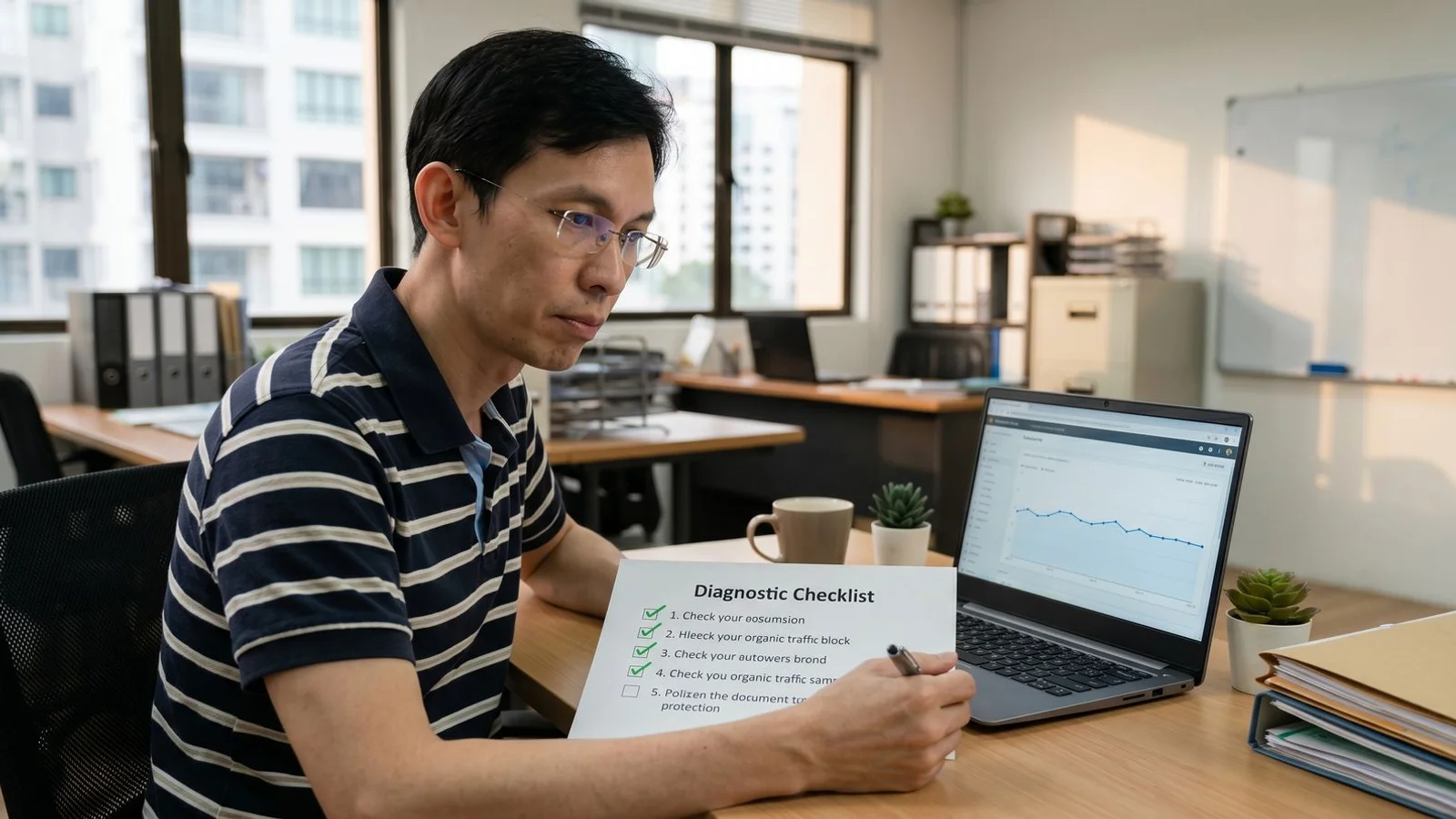
We see it every day across the Malaysian business landscape.
Founders pour money into marketing, but their digital growth hits a frustrating plateau. Our team at Adam SEO, established in 2011, knows that search rankings mean absolutely nothing if they do not deliver tangible ROI.
This missing ROI is exactly what prompts smart operators to look for signs you need seo support. If several of the symptoms below apply, a good next step is to review our full range of SEO services and decide whether a targeted engagement fits your situation.
We are going to break down the specific symptoms that indicate your current strategy is failing. Let’s examine the data, clarify what it actually means, and explore a few practical ways to respond.
The five symptoms
If any of these apply, professional SEO is likely a better ROI than continuing your current approach. We consistently observe that a proactive search strategy is the difference between stagnation and growth. Once you decide SEO is the right move, our guide on how to choose an SEO agency in Malaysia walks through the qualifying questions worth asking any shortlisted partner.
Data from the 2025 e-Conomy SEA Report reveals that the Malaysian digital economy surged by 19 percent to reach US$39 billion. Your competitors are actively capturing this massive online demand.
Our agency experts know that failing to rank means leaving money on the table.
1. You’re losing ground to specific competitors on Google
You remember ranking on page one for your main service in your city. Now competitor X sits there instead, and your clicks, calls, and lead volume track that loss.
What it’s telling you: the competitor is investing in SEO or capitalized on a recent Google algorithm update. We often see businesses lose out because they ignore major shifts, like the massive Google core update in December 2025. This algorithmic change heavily rewarded sites showing genuine, direct experience and penalized outdated pages. Either way, your position is not going to recover on its own, and every month you delay, their backlink advantage compounds.
What to fix: commission a competitor gap analysis using industry tools like Ahrefs or Semrush. Identify their content, their links, and their technical edge, then close the gap systematically. Our gap analysis process typically reveals three common deficits:
- Missing local backlinks from credible Malaysian business directories.
- Outdated service pages lacking detailed pricing or procedural transparency.
- Slow mobile page load speeds compared to top-ranking rivals.
2. Your Google Ads CPA is climbing every quarter
You are running Google Ads. You used to pay RM 80 per lead, but now you are paying RM 130, and next quarter it will be RM 150.
What it’s telling you: auction competition is intensifying. We know that customer acquisition costs for online buyers in Malaysia climbed by 23 percent in 2025, according to Mordor Intelligence. More competitors, higher bids, and tighter margins mean a paid-only approach is a losing economic trajectory.
What to fix: shift a percentage of your ads budget into SEO. Our clients who reallocate even 30 percent of their budget over 12 months successfully build an organic channel that reduces dependency on the auction. This diversification provides a critical buffer against rising CPC inflation.
| Marketing Channel | Short-Term Impact | Long-Term Cost Trend |
|---|---|---|
| Google Ads Only | Immediate visibility | Rising acquisition costs (up 23% in 2025) |
| Hybrid (Ads + SEO) | Balanced lead flow | Stabilizing margins over time |
3. Your organic traffic is flat despite publishing content
You have been publishing blog posts for 18 months. Your organic traffic chart is a flat line.
What it’s telling you: your content is missing either topical authority, technical health, or search-intent alignment. We constantly remind clients that publishing volume without strategy simply does not rank. Usually, an underperforming site is missing all three crucial elements.
What to fix: get a content audit and a topical map. Our strategy involves focusing heavily on information gain to ensure every post offers unique local insights. Google’s late 2025 updates specifically suppressed unhelpful compilation-style articles. To recover or grow traffic, your content must include:
- Original data or local case studies.
- Clear, actionable steps for the reader.
- Media elements like diagrams or custom graphics.
4. You’re invisible in Google’s Map Pack for your services
Someone in your city types “air-con servicing PJ” or “dental clinic Mont Kiara” or “law firm Bangsar”, and your competitors fill the 3-pack. You do not appear.
What it’s telling you: your Google Business Profile isn’t optimised, your review volume is behind, or your category signals are wrong. We rely on 2026 data from Backlinko showing that 42 percent of local searchers click directly inside the Google Map Pack. All three of these visibility issues are completely fixable.
What to fix: Map Pack optimisation is its own specialism, so start with our Google Business Profile Optimisation Guide. Our local experts know that securing the number one position in the Map Pack yields an average click-through rate of 17.6 percent.
- Collect 20 to 30 new, genuine reviews every month.
- Reply to all customer feedback within 24 hours.
- Ensure your business name, address, and phone number match across all online directories.
5. Search Console shows impressions without clicks
You check Search Console. Your site is showing up for 50,000 monthly impressions, but your click-through rate is 0.8 percent.
What it’s telling you: you rank for queries that generate searches, but your title, meta description, or SERP snippet isn’t compelling enough to earn the click. We have watched organic click-through rates change drastically as AI Overviews take over the search results. A 2025 study from GrowthSRC revealed that the organic CTR for position one actually dropped by 32 percent to roughly 19 percent. Or, you rank deep in position 15 to 30 where nobody scrolls.
What to fix: title-tag and meta-description optimisation, snippet-feature targeting like featured snippets and People Also Ask, and a push to move position 11 to 20 rankings into the top 10. Our technical optimization efforts prioritize targeting these new AI-driven SERP features to win back lost traffic.
In 2026, ranking position number one matters less than capturing the AI Overview snippet.
When one sign is enough
Any one of the above is enough to justify a professional SEO conversation. Two or more, and the case is open-and-shut.
We apply a very simple rule when evaluating campaigns.
If your competitor invests in SEO and you do not, you lose market share, even if your product is objectively better.
If you are constantly asking yourself “do i need seo”, waiting for the perfect moment will just cost you more later. SEO is the distribution layer for your offer. Ignoring it means ignoring how Malaysian buyers actually find services in 2026.
Our team knows that search is a zero-sum game.
The counter-signals: when SEO isn’t right for you
SEO isn’t always the right fit. Hold off if your business lacks runway, search demand, or product-market fit.
- You have under 12 months of cash runway. SEO is a 6 to 12 month ROI horizon. Tight runway favours ads.
- Your vertical has zero search demand. If nobody searches for what you sell, rankings are irrelevant. Invest in content marketing or direct sales instead.
- You’re pre-product-market fit. Solve product-market fit first, then amplify via SEO.
- Your unit economics don’t support it. If your LTV is under RM 500, SEO retainers won’t pencil out. Low-touch paid or organic social usually fit better.
We tell prospects the hard truth about their financial readiness. A solid B2B software lifetime value in Malaysia sits around RM 10,000, making long-term SEO highly profitable. If your margins are razor-thin, you need a different acquisition strategy.
DIY vs agency vs in-house hire
Knowing when to hire seo agency professionals depends entirely on your budget and internal resources. We help clients weigh their options based on realistic market costs. Recent 2025 salary data from JobStreet shows that an average mid-level in-house SEO specialist in Malaysia earns around RM 48,000 to RM 72,000 annually.
- DIY: works for hyper-local, low-competition queries. Almost never works for anything competitive.
- Single in-house hire: struggles to cover technical, content, and links simultaneously. Good for specific brands with deep technical products, but too much scope for most SMEs.
- Agency: spreads workload across specialists. Best fit for SMEs needing full-stack execution on a monthly budget.
Our clients often find that partnering with an agency provides a complete team of experts for less than the cost of one senior hire.
Next steps
You can treat this guide as your initial seo self assessment. If you ticked one or more of the five signs, the logical next read is How to Choose an SEO Agency in Malaysia, as it walks through the red and green flags for agency evaluation.
We strongly recommend reviewing pricing benchmarks to plan your budget. For pricing, see How Much Does SEO Cost in Malaysia?. Our team is ready to evaluate your website’s true potential.
Or request a free discovery audit, and we will benchmark your situation against all five signs and give you an honest assessment of whether professional SEO is the right investment now.