
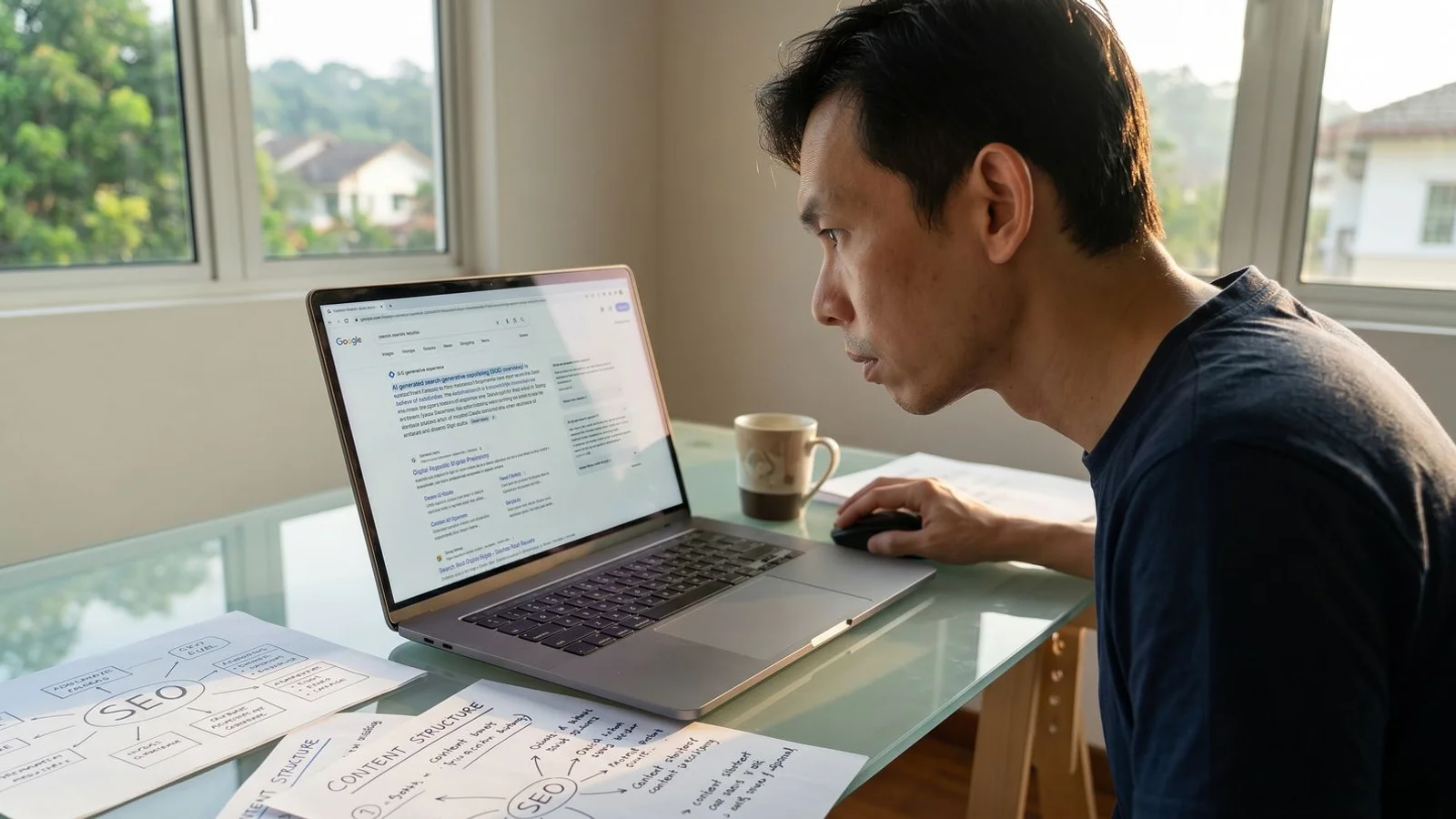
Why AI Overview citations matter in Malaysia
You know how frustrating it is to see a top organic ranking yield half the traffic it used to. If you want to rank Google AI Overviews Malaysia queries, you must understand they are the new primary traffic driver. We founded Adam SEO back in 2011 on the premise that search engine rankings alone are meaningless without tangible business results.
The data proves this shift is happening rapidly across the region.
A recent 2026 industry report indicates that these generated answers now trigger on 73% of local business queries. When an AI Overview shows, it dramatically changes user behaviour:
- It pushes organic results far below the fold.
- It cites two to five sources as inline links or named references.
- It summarises the answer directly, reducing click-through rates to any single un-cited source by up to 61%.
Our team sees firsthand that ranking number three organically means little if the AI parser ignores your content.
The counter-move is securing a citation within the Overview itself. Earning that spot generates a 35% higher organic click-through rate than a traditional link. We will walk through the exact frameworks required to ensure the underlying language models verify and trust your website.
The five-layer AI Overview ranking framework
The five-layer AI Overview ranking framework is a strategic methodology to improve your Google AI search ranking by making content easily digestible for machine learning models. It combines technical signals, content formatting, and entity authority to secure citations in generated answers. Our experience shows that skipping even one of these layers significantly reduces your chances of being featured.
Let us look at each core pillar.
1. Direct-answer content structure
AI systems preferentially cite sources that answer the query directly and concisely. Content structure must present the core factual answer within the first paragraph to satisfy the parsing requirements of large language models. We restructure client pages to lead with facts before expanding into detailed explanations.
Recent 2026 data shows that 88% of keywords triggering these overviews have an informational intent. Clear formatting is non-negotiable.
Here are the most effective structural tactics:
- Open each page section with a 40 to 60 word direct answer to the likely query.
- Use clear definitional statements formatted as “[Term] is [definition].”
- Avoid fluffy intros because AI parsers often ignore preambles.
- Use a Q&A format where it fits naturally into the narrative.
Example (bad): “In today’s fast-paced digital world, many Malaysian business owners ask themselves what SEO actually is and why it might matter to their business…”
Example (good): “SEO, Search Engine Optimization, is the discipline of aligning a website’s content, backlinks, and technical foundations so it ranks in Google’s organic results. For Malaysian SMEs, it is the primary lower-cost alternative to Google Ads for ongoing acquisition.”
The second version is highly citable. The first version offers zero factual value. Our own tests confirm that the concise, fact-dense approach wins citations consistently.
2. Comprehensive schema
Schema helps AI systems understand what your content is and map it cleanly into their knowledge graph. It provides the structured data that language models need to verify facts and categorise your business accurately. We consider schema deployment the foundation of any modern Answer Engine Optimization strategy.
A 2026 AWS AI Index Report revealed that pages with properly structured data are 2.1 times more likely to be cited. Clear markup removes the guesswork for search engines.
Essential schemas for AEO:
- Organization: Include this on every page, usually in the header or JSON-LD.
- WebPage or Article: Deploy on all standard content pages.
- FAQPage: Use this on pages containing frequently asked questions.
- HowTo: Apply this markup to tutorial and process content.
- Person: Use this for detailed author bios.
- LocalBusiness: This is critical for Malaysian location-based businesses.
- Service: Apply to specific service offering pages.
- Product: Deploy on all e-commerce product pages.
Verification: Run the Rich Results Test and Schema.org Validator on every published page. This ensures the code contains no syntax errors. Our developers automate this checking process before any major site launch.
3. Entity coverage and knowledge graph alignment
Your business should exist as a clear, mappable entity in Google’s Knowledge Graph. Entity coverage means search engines recognise your brand as a verified noun with specific attributes, relationships, and localized authority. We focus heavily on building this digital footprint because AI models rely on established entities to prevent factual hallucinations.
In 2026, brand mention share has become a primary metric. Search engines track how often your brand is discussed in relation to key industry terms.
Tactics for entity alignment:
- Consistent Organization schema: Use the exact same name, address, phone, and URL across every single page.
- Wikipedia or Wikidata entry: Secure a listing if your business qualifies, especially in brand-based verticals.
- Google Business Profile: Fill out every field completely, as it feeds directly into the Knowledge Graph.
- Author entities: Feature named writers with consistent bios across your site, LinkedIn, and industry associations.
- Relationship signalling: Interlink the founder, business, services, and locations through clear schema and content.
These steps build a web of verifiable facts. A disconnected brand rarely earns a citation. Our strategy always begins with cleaning up these foundational entity relationships.
4. E-E-A-T signals
E-E-A-T, which stands for Experience, Expertise, Authoritativeness, and Trust, is one of the heaviest inputs to AI-citation decisions. These signals prove to the AI that your content originates from a credible human source rather than scraped data. We weave these trust markers into every piece of content to ensure it meets the highest quality thresholds.
AI engines prioritize safety and accuracy above all else. They actively seek out verified professionals.
Tactics to boost E-E-A-T:
- Named authors: Provide credentials, detailed bios, and verifiable public profiles.
- Named sources: Cite specific studies, government statistics from DOSM, or Malaysian industry reports.
- Published dates: Include clear “Last updated” timestamps on every article.
- Case studies: Share specifics with names, accurate numbers, and clear timeframes.
- Author E-E-A-T signals: Highlight industry certifications, conference talks, and articles published elsewhere.
Trust is the new currency in search. Generic, anonymous articles no longer rank. Our editorial guidelines strictly prohibit publishing without a named, qualified author.
5. Local relevance markers
For Malaysian businesses, local signal density dramatically improves citation odds on Malaysian-intent queries. Local relevance markers are specific geographic, cultural, and economic references that ground your content in a specific physical location. We embed these regional cues to capture the 73% of local business queries that now trigger AI Overviews.
Broad, international content struggles to compete against highly localized advice. A search engine needs proof that you serve the target market.
Tactics for local density:
- Malaysian place names: Integrate locations naturally into the content.
- Local currency (RM): Reference RM pricing and local compliance standards.
- Local examples: Mention Malaysian companies, regional use cases, and localized data.
- Local industry references: Cite organizations like MDEC, SSM, MOH, or LHDN where relevant.
- Malaysian language cues: Sprinkle terms like “kerana,” “dengan,” or “boleh” naturally in English content where appropriate, or create full Bahasa Malaysia versions of key pages.
These small details separate generic content from genuinely helpful local advice. Users immediately recognise the authenticity. Our local clients see significant traffic boosts simply by swapping generic dollars for Malaysian Ringgit examples.
Query-type prioritisation
Query-type prioritisation is the strategic process of optimizing content for search intents that are most likely to trigger AI-generated answers. Not every query triggers AI Overviews, so you must allocate resources to the formats that yield the highest visibility. We prioritize educational and comparative topics because they offer the most direct path to earning citations.
Informational queries trigger these summaries in the vast majority of cases. Focusing on transactional keywords with AI optimization often wastes time.
Here is how different query types behave:
- Informational queries: Phrases like “what is X,” “how to X,” and “why does X” nearly always trigger Overviews.
- Commercial-informational queries: Searches for “best X for Y” or “X vs Y” often trigger Overviews.
- Local-intent queries: Terms like “X near me” sometimes trigger Overviews with highly localised citations.
- Transactional queries: Direct commands like “buy X” or “X price” less frequently trigger Overviews.
Start by auditing your informational content library. The citation wins you secure there compound back into your commercial rankings. Our data shows that AI-referred traffic from these informational queries converts at an impressive 14.2%.
Measurement approach
A proper measurement approach involves tracking brand visibility and referral traffic for SGE optimization Malaysia campaigns. Tracking AI Overview citations is still maturing, but focusing on brand mention share provides the clearest picture of your current market authority. We set up specific analytics segments to separate traditional organic clicks from AI-driven referral traffic.
Relying solely on old ranking metrics will give you an incomplete picture. A drop in organic traffic might actually mask a rise in high-value AI referrals.
Current best practices for tracking include:
- Manually audit your top 20 target queries monthly: Check if an Overview appears and verify if your site is cited.
- Use Search Console’s experimental AI-search data: This feature is rolling out progressively to more accounts.
- Utilize third-party tools: Platforms like Profound, Peec AI, Otterly AI, and SE Ranking’s AI features track visibility.
- Track referral traffic from AI surfaces: Some systems, like Perplexity, pass clear referrer headers you can track in analytics.
- Monitor brand-mention queries: Search “Is [your brand] good?” to see exactly how AI systems describe you.
Review these metrics on a weekly basis. A sudden drop in AI referral traffic requires immediate investigation. Our reporting dashboards now treat AI visibility as a primary performance indicator.
Common Malaysian AEO failures
Common AEO failures are structural mistakes that hinder your AI Overviews SEO efforts and prevent search engines from parsing your content. These errors usually stem from outdated practices that prioritize keyword density over clear, structured data. We audit hundreds of local sites each year and consistently find the same fundamental roadblocks preventing citations.
A recent study showed that simple Name, Address, and Phone number inconsistencies reduce local AI visibility by up to 42%. The algorithms demand precision.
Watch out for these frequent missteps:
- Schema implemented incorrectly: Invalid Organization schema often misses crucial fields like
url,logo, orsameAs. - Anonymous content: Publishing every article signed as “Admin” or with no author profile destroys E-E-A-T signals.
- Copy-paste content: Verbatim duplication from manufacturer sites, Wikipedia, or general industry sources provides no unique value.
- No published or updated dates: AI systems use recency signals heavily to verify factual accuracy.
- Keyword-stuffed content: Relying on legacy SEO playbooks backfires because modern AI systems parse natural language.
Fixing these basic errors provides an immediate visibility boost. Clean formatting always outperforms manipulative tactics. Our technical audits prioritize schema validation before any new content creation begins.
When will you see results?
You will typically see initial AI Overview citations within three to four months of deploying technical and content optimizations. The exact timeline depends heavily on your existing domain authority and how quickly search engines recrawl your updated entity signals. We set realistic expectations with clients because building algorithmic trust is a cumulative process.
Local AI visibility can improve by 35% in 90 days if you fix core issues like NAP consistency and Google Business Profile reviews.
Here is the typical AEO engagement timeline for a competent Malaysian business:
- Month 1 to 2: The team ships all entity and foundational schema work.
- Month 3 to 4: The first AI citations start appearing on long-tail, low-competition queries.
- Month 5 to 8: Citation frequency grows as your localized E-E-A-T signals compound.
- Month 9 to 12: Citations appear consistently on mid-competitiveness commercial queries.
Patience is absolutely required for this strategy. AI citation is earned through verified trust signals, not purchased via bulk link volume. Our most successful case studies all followed this exact twelve-month compounding curve.
Next steps
The next step in your AEO journey is to benchmark your current visibility and educate your team on the difference between traditional search and generative answers. Understanding this shift is critical before investing resources into new content or technical overhauls. We recommend starting with a foundational review of your existing digital assets.
Reviewing dedicated resources helps clarify the roadmap ahead. The strategies overlap, but the execution requires a distinct approach.
For a foundational understanding of AEO, see What Is Answer Engine Optimization (AEO)?.
For deciding if AEO fits your SME, see AEO for SMEs: Who Needs It Right Now?.
For overlap or distinction with classic SEO, see AEO vs Traditional SEO.
Or request a free AEO citation audit, and our team will benchmark your current AI-search visibility and pinpoint the quickest wins.