
The quick answer
Yes, you need both, and ideally, you should run them as a unified discipline rather than two separate programs. You have probably noticed the sudden shift in traffic across your marketing dashboards this year. Our team sees this directly in our regional data, where ChatGPT usage in Malaysia spiked by an incredible 330% over the last year alone.
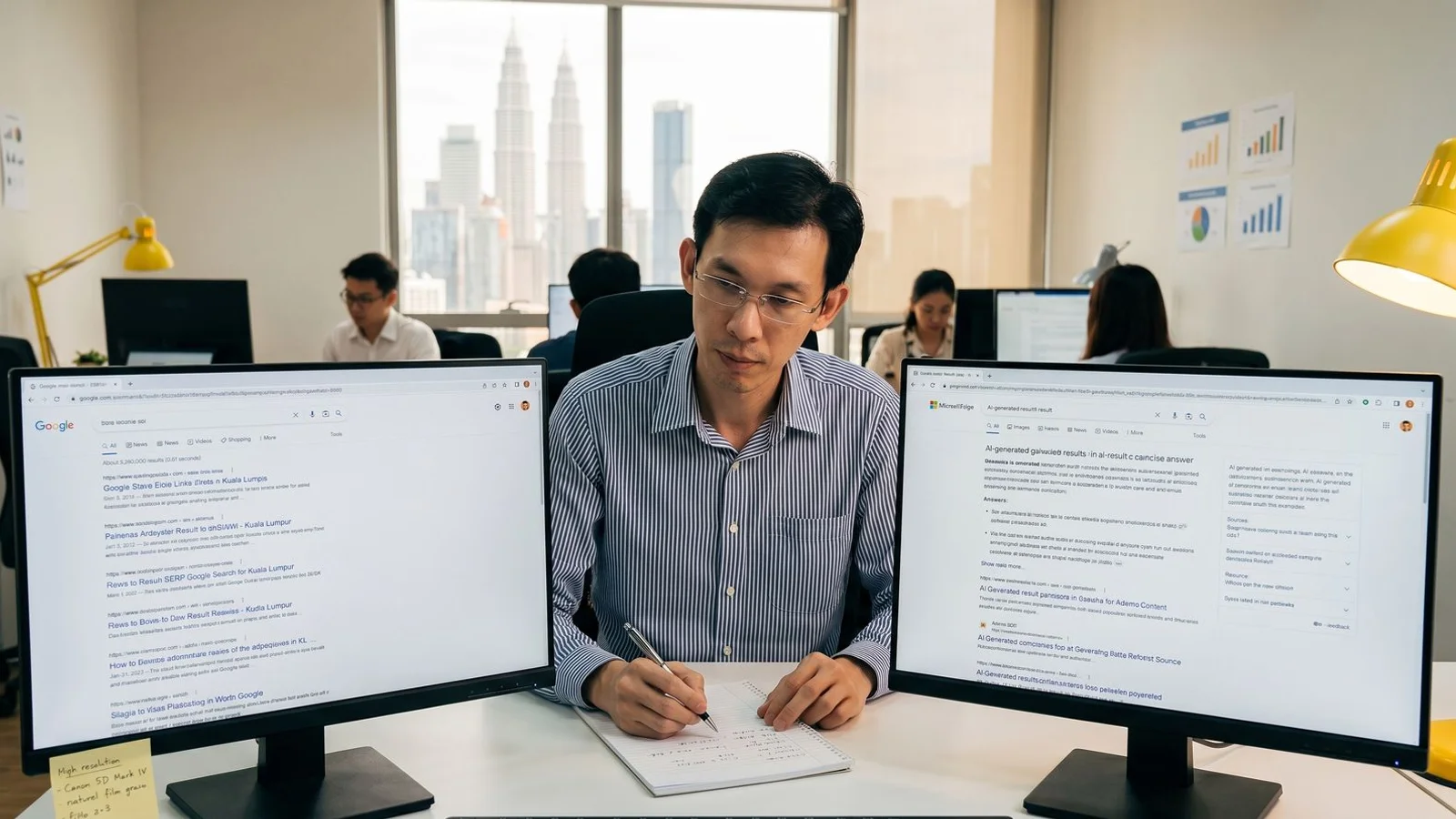
This massive migration in user behaviour settles the aeo vs seo debate. Classic SEO optimises for ranking in Google’s traditional organic results where users click through to your site. AEO optimises for being cited in AI-generated answers where users may never click through at all.
Both surfaces are queried daily by your Malaysian buyers. From what we have seen, 2026 is the year AI search actively takes over the top of the funnel, meaning you no longer have to choose aeo or seo.
We will review the data, analyse what it actually tells us about shared signals, and explore a practical unified seo aeo strategy to integrate both disciplines seamlessly.
Where they overlap
Roughly 70% of AEO and classic SEO work is the exact same work, applied with slightly different emphases. If you already have mature classic SEO, you have built the majority of your AEO foundation.
We know that Google’s algorithm increasingly relies on structured data for accurate answers. According to recent 2026 data, pages with valid Schema.org markup are two to four times more likely to appear in Google’s AI Overviews.
Shared signals
The core signals that satisfy traditional search algorithms also feed AI citation models.
- E-E-A-T: Expertise, experience, authoritativeness, and trust remain heavy inputs for both disciplines.
- Schema coverage: Structured data like JSON-LD helps both AI citation parsing and SERP rich results.
- Entity clarity: Knowing who you are, what you do, and where you operate grounds your business in the AI’s Knowledge Graph.
- Content depth: Comprehensive topic coverage feeds both ranking and direct citation.
- Technical foundations: Fast, mobile-friendly, crawlable sites win on both surfaces.
- Backlinks: External trust signals from authoritative sources validate your content.
Shared tactics
You can automate and scale these shared elements using 2026’s technical SEO tools. For instance, platforms like Rankability or Clearscope handle the heavy lifting for content depth and NLP entity extraction.
- Schema.org implementation (specifically targeting v29.x standards).
- Quality content production.
- Link earning and digital PR.
- Technical SEO health.
- Internal linking strategy.
- Core Web Vitals optimisation.
The additional 30% is where the disciplines diverge. We see many brands fail here by neglecting the unique requirements of AI engines.
Where they diverge
The remaining 30% of the work is genuinely different. A page can be well-optimised for one surface but completely fail on the other.
Our clients often ask how the specific mechanics differ. Industry data from 2026 shows that AI-referred visitors convert at an impressive 14.2%, compared to approximately 3.2% for traditional organic search. This massive gap highlights why understanding these differences is critical.
To clarify the distinctions, we have mapped out the core differences across structure, metrics, and entity work.
| Strategic Area | Classic SEO Focus | AEO Focus |
|---|---|---|
| Content structure | Optimises for search-intent match, keyword coverage, and scannable marketing layout. | Optimises for direct-answer citability, concise definitions, and a Q&A textbook style. |
| Success metrics | Rankings, clicks, impressions, and organic revenue attribution. | AI citations, mention frequency across engines, and indirect brand-query lift. |
| Entity work | Helpful but not strictly mandatory for ranking. | Foundational, as AI systems cannot cite you without clean entities. |
| Freshness emphasis | Matters mainly for QDF (Query Deserves Freshness) topics. | Matters broadly, because AI systems heavily bias recent content. |
| Author signalling | Author bios and E-E-A-T matter, but are rarely make-or-break. | Essential, as unnamed or poorly-credentialed content is rarely cited. |
We closely monitor citation authority, which has become the primary ranking factor for engines like Perplexity. Perplexity now holds over 5% of the AI chatbot market share in Malaysia, making author signalling and verified credentials non-negotiable. The measurement tooling for AEO is still maturing, whereas classic SEO tooling is mature and reliable.
Duplication risks and how to avoid them
The biggest pitfall when running AEO and SEO as separate programs is content duplication and contradiction. Teams frequently end up producing two different versions of the same topic.
They might publish an SEO-optimised version of “what is X” on one page, and an AEO-optimised version on another. Google sees this duplicate content and ranks neither well.
Our agency tracks Google’s updates closely, and the 2026 Spam Update aggressively targets this exact issue. SpamBrain now actively demotes domains that produce mass, low-value, or duplicative content, regardless of whether a human or AI wrote it.
Solution: Produce one content asset per topic that serves both disciplines simultaneously.
- Use AEO-style direct-answer paragraphs within SEO-optimised pages.
- Mark up these pages with schemas that serve both purposes.
- Measure both citation and ranking outcomes side-by-side.
The unified strategy playbook
Here is the exact approach we use across client engagements to build a unified presence. Founded in 2011 by SEO veteran Adam Yong, Adam SEO was built on the premise that search engine rankings alone are meaningless without tangible business impact.
We apply this philosophy directly to our unified workflow. By streamlining efforts, this approach eliminates the costly redundancies of running parallel teams.
Content pipeline
Your content must answer the machine’s questions immediately, then provide the depth a human reader demands.
- One topic = one page: Never create AEO and SEO duplicate versions.
- Direct-answer paragraph: Place a concise, factual summary at the top of each H2 section.
- Comprehensive body: Cover the SEO-optimised depth below the initial answer.
- FAQ section: Add this at the bottom for both featured-snippet and AI-citation capture.
Schema strategy
Schema Markup is no longer just an SEO tactic. It is the shared semantic layer that AI systems rely on to understand enterprise data.
- Organization, WebPage, Article: Deploy these on every content page.
- FAQPage: Implement this specifically where FAQs exist.
- HowTo: Use this on step-by-step tutorial content.
- Person: Attach this to author bios to build entity trust.
- LocalBusiness: Essential for location-based Malaysian businesses.
Measurement and Team Structure
Running separate AEO and SEO teams creates friction, duplication, and contradiction. Unified teams consistently outperform siloed departments.
- SEO metrics: Track Search Console, GA4, and traditional rank tracking.
- AEO tracking: Use manual citation auditing, or tools like Rankscale.ai and Peec AI to track brand-query mentions.
- Team alignment: Maintain one content team, one technical schema team, and one strategist coordinating both tracks.
- Reporting: Deliver insights together in a single monthly client report.
Budget implications
Running AEO and SEO as unified work typically adds 10 to 20% to a classic SEO retainer, not 100%. Adam SEO bundles AEO into all retainer tiers precisely because the marginal cost of adding AEO to a well-executed SEO program is modest.
The marginal revenue impact, by contrast, is substantial. This makes financial sense for local businesses looking to maximize their marketing spend.
For Malaysian businesses:
- If you are already on an RM 3,500/month SEO retainer: AEO integration generally costs RM 400 to RM 700/month additional.
- If you are starting fresh: Choose an agency that integrates AEO from day one rather than stacking separate vendors.
We recommend avoiding agencies that treat AI search as an entirely separate, premium-priced service. Building a unified foundation from the start is much more cost-effective.
The evolving landscape
Through 2026 and beyond, the distinction between an answer engine vs search engine will likely blur even further. We have transitioned from a link economy based on traffic referrals to an answer economy where AI synthesizes value directly on the results page.
Industry projections estimate that by 2027, nearly 65% of all search interactions will involve some form of AI mediation. This means classic organic results will increasingly integrate AI-generated summaries.
AI-answer interfaces will also increasingly cite sources with clickable links, not just named references. This convergence means businesses must prepare for three specific shifts:
- AI-generated summaries directly inside classic organic results.
- Clickable source citations replacing plain-text mentions.
- A blended search results page where AI, organic, and paid listings coexist.
Our strategic recommendation is clear. Build one unified discipline now, so your business adapts faster to every surface iteration Google releases.
Next steps
For an AEO foundation, see What Is Answer Engine Optimization (AEO)?.
For SME-specific urgency assessment, see AEO for SMEs: Who Needs It Right Now?.
For Google-specific tactics, see How to Rank in Google AI Overviews (SGE).
Or request a free unified AEO + SEO strategy review, and we will benchmark both disciplines to recommend a unified roadmap.